Tuesday, December 16, 2014

What is Scent Work?


Canine Scent Work or Nosework is a fairly new sport modeled after detection training for professional narcotics or bomb dogs.  It offers dog owners an opportunity to allow their dogs to explore their natural scenting ability in a safe and controlled environment.  The sport uses the scent of different essential oils that can be easily purchased and stored by the average person.  Dogs are taught to hunt/search for “target odours” in a variety of settings to create a mind challenging and extremely fun game for your dog to play.  Training usually begins indoors with box or container searches, and then advances to room searches, outdoor and vehicle searches.
Scent work is suited to all types of dogs and owners whether you practice for fun or competition.  Many human and/or canine disabilities are easily accommodated, as are behaviour issues including dog reactivity.  Classes and competitions are run so that each search is done individually by one dog and handler team working at a time, allowing dogs with issues to focus and learn.  Working without social stressors allows the dog and handler to be free to concentrate on the search.  As the sport is relatively “low impact” it is great for young puppies, elderly dogs and dogs with injuries.    
The sport encourages dogs to be independent as the owner has to believe in the dog’s ability to find the target odour.  It gives the dog an outlet to do what comes naturally and just “be a dog”.  This helps to promote the dog’s confidence and builds a trusting relationship between canine and owner. It also provides intense mental stimulation and many behaviour issues are reduced because the dog’s desire to search helps develop self-control and focus.

This post was written by 

Lee Anne Rogers who we are lucky enough to have running our scent work class in January

Lee Anne Rogers has been training and competing in various dog activities for 15 years.  In 2013 she graduated with honors from the Professional Dog Trainer program at Animal Behavior College and is currently taking courses from “Ethology Institute Cambridge”.  She actively competes in Agility and Nosework with her English Springer Spaniel “Drifter”.
Lee Anne is working on completing the requirements to become certified as a Nosework Instructor through the “National Association of Canine Scentwork®”.  She has attended seminars for Nosework with Ron Gaunt, Amy Herot and Jill Marie O’Brien and she recently participated in a 5 day K-9 Nosework camp in Pennsylvania where she learned from some of the top instructors.           

Wednesday, September 10, 2014

How to Introduce Another Animal into the Family

We have been very lucky to introduce a new family member this summer.  Her name is Penny and she is a very cool coloured cat.  I thought I would share how I go about introducing my animals to each other.


Introducing a new animal into the household is always stressful. You have a happy cohesive group and any changes might not always work out the way you hoped. Familiarity is the key. Be it a new kitten, a new puppy or even an adult animal the approach is similar.

Safe Zones
Creating a safe space is vital. Coping with change is easier when you feel safe. The same applies to animals.
  1. Create a safe zone for the new family member. X-pens and crates work well but baby gates also do the trick. This is a space intended for the new member only. No other animal should be allowed inside it.
  2. Ensure the safe zone has all the necessities: water, food, toys, and litter.
  3. Provide something for the new member to hide in or behind if she gets scared.  A crate or even a box will work.
The Introduction
  1. Put all other animals away, in their crates, outside or in another room behind a door.
  2. Introduce the new family member to the safe zone.
  3. Once the new family member starts to explore her safe zone, release the other animals one at a time.  If you have multiple animals start with your calmest and work your way up.  Take your time.
When you release the others, they will run over and sniff the safe zone. This will likely scare the new member. Let them be unless you end up with unacceptable behaviours such as; non stop barking, aggression, charging, etc. They will soon get bored and go about their day. The animals (old and new) will sniff and interact with each other through the barriers of the safe zone.  


The Great Release
Once you see that the animals have reached a level of familiarity, you are ready for the release.
  1. Have only one animal in the room, again starting with your calmest animal.  Wait until everyone has settled down and are not standing at the gate waiting.
  2. Open the safe zone to allow the new member to come out and investigate. Make sure she can ran back to be safe whenever she feels the need.
  3. Allow the animals to interact under your supervision.  Be prepared to intervene but at the same time don't panic.
Building familiarity takes time ... for both old and new
Safe environments are required for both animals to get comfortable with each other. The length of time required before everyone is comfortable varies. Don’t force it. 

Work with the existing group is required. Remember basic training principles and reinforce the good behaviours. Having multiple animals can offer interesting training options. For example, if the old dog barks at the new puppy (excessive barking remove the old dog), toss treats into the safe zone so the puppy gets a reward every time he got barked at.

Build up freedom little by little. Taking the time to make introductions is the foundation to building good relationships within your family.

What have you done to introduce your new animals? Share your strategies and tips by commenting below!


Monday, August 18, 2014

Being A Dog Ambassador

This past weekend Iggy and I got to interact with a group of people who are frightened of dogs. They come from a culture where dogs aren’t part of the daily social interaction. Nonetheless, they were curious and drew near. I took it upon myself to provide these “could-be dog lovers” a positive experience with my dog.
About 10 children approached us. I could hear one say that he was scared of dogs. I stopped and asked Iggy to sit. The kids surrounded us, keeping a safe 5-foot distance, and leaned in to look at Iggy. Because Iggy responded favourably to my commands, the kids soon felt at ease and wanted to know more about the dog. They came out of their shells and asked some great questions like “what’s his name” and “what kind of dog is he”.
Later on, a lady and her daughter approached. They asked if they could pet the dog but seemed very hesitant. I turned Iggy around, held his head, and suggested they pet his bum. Petting the hindquarters works well with people who really want to pet the dog but are too scared to do so. Of course, I would only do this with a dog who was very comfortable being touched by strangers and having his bum touched.
Keys to being a dog ambassador
  1. Be sure that your dog has mastered the “stop” and “sit” commands.
  2. Absolutely no touching unless your dog is comfortable being touched.
Winning them over a little at a time

I am thrilled that Iggy and I got the opportunity to introduce people who were very uncomfortable with dogs to a great experience with a dog. Hopefully, with a number of good experiences these kids will grow up to at the very least be comfortable around dogs.

What have you and your dog done to be good ambassadors?

Wednesday, July 23, 2014

Summer Is Here - What you need to know to keep your dog safe.

Summer is in full swing and what a great summer it has been.  Iggy and I have been lucky to enjoy our favorite summer activities; swimming, camping and outdoor agility.  While you are out enjoying the great summer weather, it is good to keep in mind some possible dangers for your dog.

Heatstroke/dehydration

Dogs are not great at dealing with heat.   They do not sweat like we do, and have a very hard time cooling themselves down, especially when the humidity is high. We all know not to leave our dogs in a hot car for any period of time.  Here are some other tips to keep your dog safe when it is hot.  If you have an older dog or a brachycephalic (short nosed) dog you have to be even more careful.
  • always make sure your dog has water and shade
  • schedule exercise for morning and evening when it is cooler
  • some dogs don't know when to stop, make sure your dog is resting and cooling himself off on a regular basis and drinking plenty of water
  • evaporative cool coats are great, but a wet towel covering the dog will also do the trick
  • watch your dogs pads if walking on hot pavement it could burn them
Some signs of heat stroke are
  • excessive panting or difficulty breathing
  • drooling
  • mild weakness
  • seizures
  • bloody diarrhea or vomiting
  • stupor and collapse
Water Intoxication

Water intoxication is another possible danger you should be aware of.  Especially since most of us like to take our dogs swimming for exercise during the hot summer months.

Dogs drink water while they swim.  Some drink a lot of water.  I like to limit my dogs swimming time and give him breaks when we are at the water all day.  Allow all that water to go through his system before he goes in the water again.


Here is an article with some more information for you

Water Intoxication Article

Get out and enjoy this glorious weather we have been having.

Leave a comment with what your dogs favorite thing to do in the summer is.

Monday, June 16, 2014

Agility Training Builds Lasting Bonds and Friendships

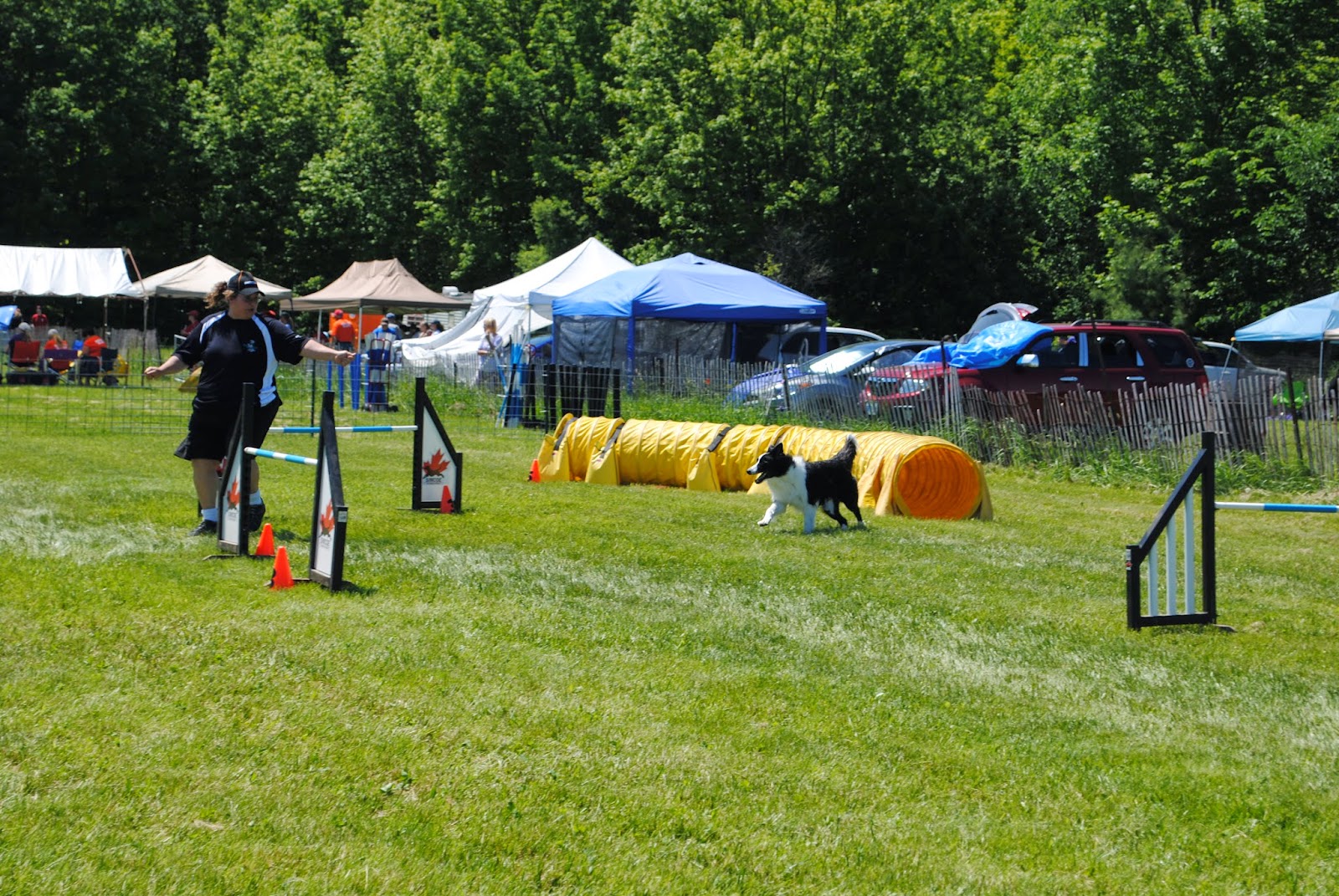
I recently attended the Agility Association of Canada's Ontario Regional Championship with my young border collie, Iggy. What a display of different dogs and skill levels! The teamwork between the handlers and their dogs was incredible. The dogs and handlers work hard running six courses in two days.  How did they do it? Or maybe the better question is:  why did they do it?

 Because theses dogs and handlers have trained hard. The handlers have learned how to work with their dogs and build value for working together.  Agility training with your dog takes your connection with him to a whole new level. It challenges you to learn what motivates your dog; it challenges him to focus on and respond to your commands despite all sorts of distractions. Mind you, not every moment is a brilliant one but the love and bond created is everlasting.

Agility training with Iggy and my previous agility dogs, has helped me become a better trainer. It's taught me to become more respectful of dogs.  To learn that they will tell you everything you need to know to train them, you just have to pay attention. If you're looking for ways to deepen your bond and relationship with your best friend, come check out one of our free demonstrations.
  • Canada Day in South Mountain keep an eye on our calendar for times
  • Chesterville Fair - Friday July 25 at 3:30pm and 5pm

 So, how did Iggy do?  Iggy surpassed all my goals for this weekend and I am looking forward to training all the holes we found. Take a look at the video and leave your impressions in the comments below! 
 

Thursday, May 22, 2014

How to Teach a Dog to Not Jump on People

Meeting people always seems to be a stimulus for jumping. To get a handle on this undesirable behaviour, establish in your mind what you want to see instead of jumping: sitting. In this exercise, you'll be rewarding your dog frequently so I recommend using your dog's dinner as a reward.

Establishing the alternate behaviour: reinforcing the sit
Practice the "sit" command repeatedly when walking your dog. Throughout the walk, call his name and ask him to "sit". Reward him for sitting every time with some of his dinner. Build some "stay" into the behaviour by using multiple rewards for every sit, don't forget to release with an "OK". If your dog gets really good at this, make it more challenging by trying to get him to sit while you are still moving.

Preparing for the greeting
Once you have mastered the "recall" and "sit" commands on your walks, you're ready to try the next step: meeting people.

As soon as you see someone walking down the street, call your dog and ask him to sit. Reward him. Say "OK", move a few steps, and ask him to sit again. Repeat this until you know your dog is starting to lose his brain because the person is getting closer. At that point, stand on the leash where it touches the ground, while still holding the handle. Reward him continuously as long as he remains seated. Stop rewarding him if he gets up. Don't worry, as long as you have your foot on the leash, he won't be able to jump or lunge.

Success comes with practice
Repeat this with everyone you encounter. Build value for the appropriate behaviour. Keep working on it. Your dog's jumping history and his general fondness for people will dictate how long it will take before he understands that he shouldn't jump on people. Regardless of how quickly he gets it, continue to reinforce his ability to sit when people approach.  When you feel he understands to sit when approaching people start to increase difficulty by calling when the person is closer and closer.

If your dog is strong or a handful on leash, try having two leashes on your dog: one leash in your hand, the other leash under your foot. This gives you the ability to prevent the jumping while not letting go of the leash.


Let me know how you make out by commenting below!


Wednesday, March 26, 2014

How to Overcome a Socially-Challenged Dog

He lunges. He barks. He's just unruly when faced with ... well anything. There are a number of reasons why it happens but knowing the reasons doesn't make it any easier for you to take him out in the public. These kinds of dogs get left at home because their behaviour is unpredictable. Especially if they are large dogs because their unpredictability becomes a liability.

Dogs that lunge and bark on leash are "reactive" in nature. Some of these dogs are pretty well-behaved off-leash but they are seldom off-leash because their on-leash reactions cause everyone to be scared of them. Reactive dogs can react inappropriately to anything.

Causes of Inappropriate Reactions

Dogs can exhibit inappropriate reactions for a variety of reasons. For example, when he sees another dog, his reaction can be triggered by:

  • Fear - he's afraid of the other dog
  • Excitement - he's thrilled to see another dog (unfortunately, the excitement usually looks like aggression)

Whether the reaction is fear or excitement, it's probably due to a combination of breed, temperament, and past experience.

Taming the Reactive Dog: Basic Obedience

Our ideal dog is non-reactive: one who watches dogs (for this blog we are talking specifically about dogs but the training applies to other distractions) go by and doesn't care. Training "no reaction" (alternate behaviour) is always a challenge. I see correction commonly used with these dogs.  Correcting a frightened dog puts him further into a state of fear. Correcting an excited dog just gets him more excited. Let’s start with some basics:

Step 1: Basic Obedience. Your dog needs to respond to three basic commands: sit, come, and walk on-leash.

Step 2: Introduce Controllable Distractions. Does your dog respond to commands when you don’t have his full attention? He needs to be able to disengage from the environment and respond to your command immediately.

If you’re finding step 2 difficult, you’re not alone. Shake-a-Paw’s new “Confidence & Composure” class is designed to teach you how to enable your dog’s journey to becoming a non-reactive dog.

What makes your dog go nuts? Share your story below!